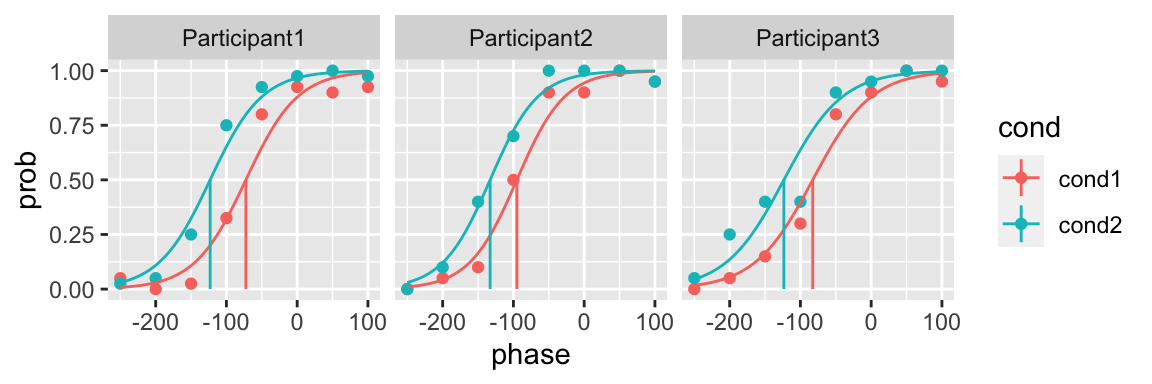
initial_parameters
Without providing initial parameters
If the function to fit (fun argument) is one of the predefined functions (cum_normal_fun, logistic_fun or weibull_fun), quickpsy calculates the initials parameters for you
library(quickpsy)

fit <- quickpsy(qpdat, phase, resp, grouping = c("participant", "cond"),
                fun = logistic_fun,
                bootstrap = "none")

plot(fit)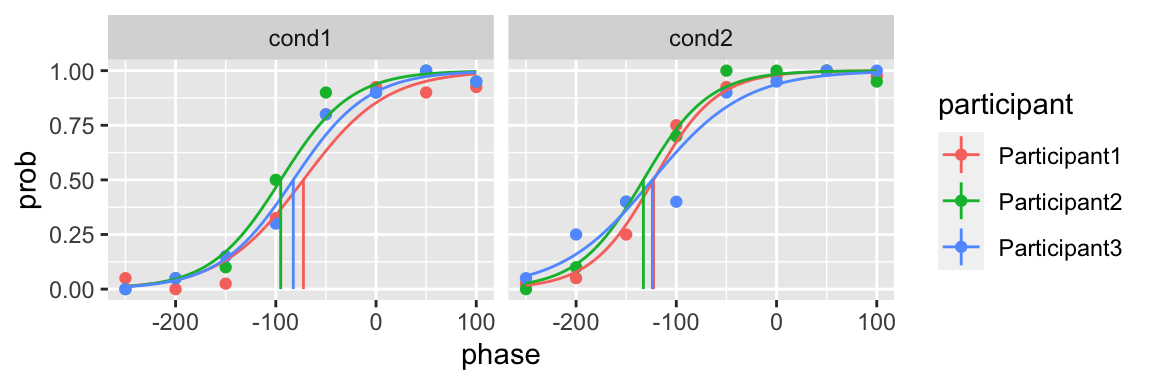
A vector initial parameters
The initial parameters could be a vector
library(quickpsy)

fit <- quickpsy(qpdat, phase, resp, grouping = c("participant", "cond"),
                parini = c(-100, 70), # the default function is cum_normal_fun
                bootstrap = "none")

plot(fit)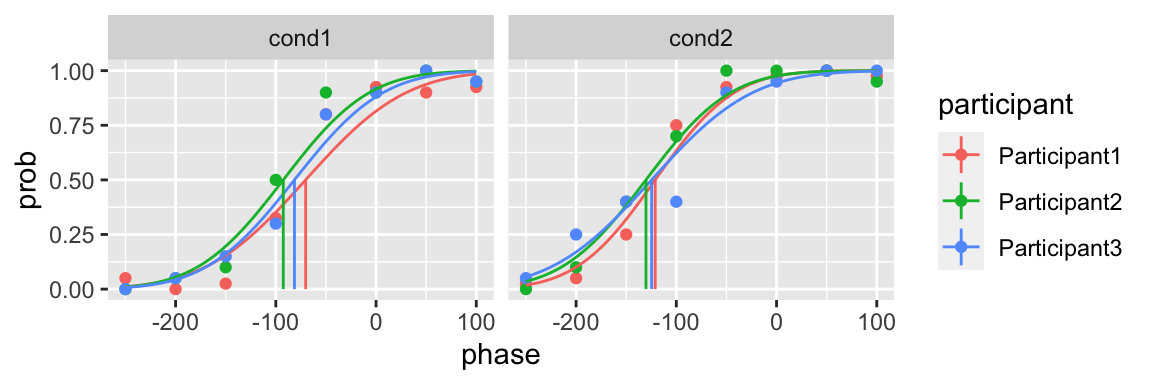
A list of initial parameters
The initial parameters could be a list in which each component constraints the lower and upper bounds of the parameter (for example, list(c(par1min, par1max), c(par2min, par2max)))
library(quickpsy)
fit <- quickpsy(qpdat, phase, resp, grouping = c("participant", "cond"),
parini = list(c(-300, 300), c(10, 200)),
bootstrap = "none")
plot(fit)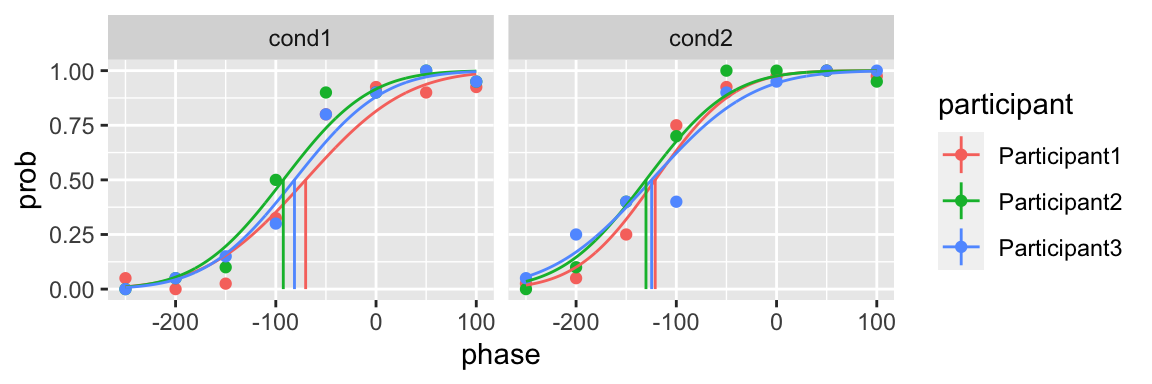 In addition of the upper and lower bound, you can also specify the initial guess of the parameters
library(quickpsy)

fit <- quickpsy(qpdat, phase, resp, grouping = c("participant", "cond"),
                parini = list(c(-300, 300), c(10, 200)),
                parinivector = c(-100, 70),
                bootstrap = "none")

plot(fit)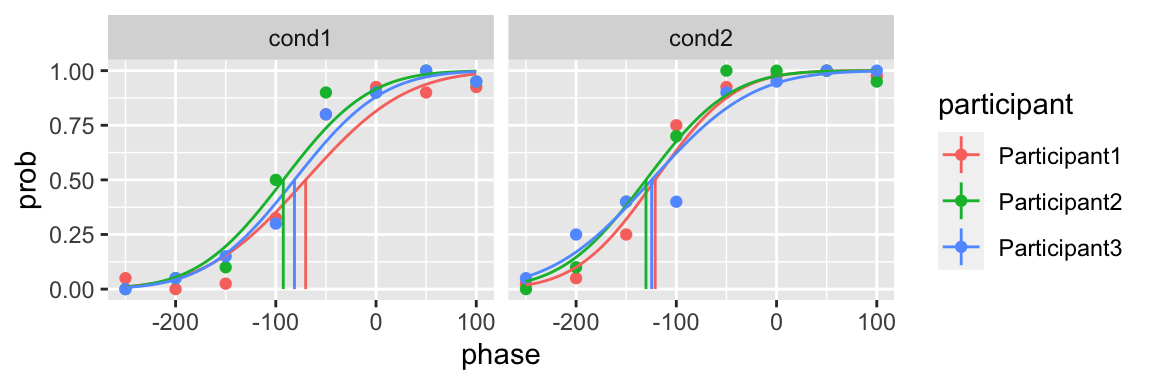
A dataframe of initial parameters
The initial parameters could be a dataframe specifiying the initial parameters for each condition. It should have the same structure that the component par of quickpsy. It is up to you how to build this dataframe. For example:
library(dplyr)
library(tidyr)

participants <- qpdat %>% distinct(participant)
conditions <- qpdat %>% distinct(cond)

parini <- conditions %>%
  crossing(participants) %>%
  crossing(tibble(parn = c("p1", "p2"))) %>%
  arrange(cond) %>%
  bind_cols(tibble(par = c(rep(c(-100, 70), 3),
                           rep(c(-150, 100), 3))))
parini
#> # A tibble: 12 x 4
#>    cond  participant  parn    par
#>    <chr> <chr>        <chr> <dbl>
#>  1 cond1 Participant1 p1     -100
#>  2 cond1 Participant1 p2       70
#>  3 cond1 Participant2 p1     -100
#>  4 cond1 Participant2 p2       70
#>  5 cond1 Participant3 p1     -100
#>  6 cond1 Participant3 p2       70
#>  7 cond2 Participant1 p1     -150
#>  8 cond2 Participant1 p2      100
#>  9 cond2 Participant2 p1     -150
#> 10 cond2 Participant2 p2      100
#> 11 cond2 Participant3 p1     -150
#> 12 cond2 Participant3 p2      100
fit <- quickpsy(qpdat, phase, resp, grouping = c("participant", "cond"),
parini = parini, bootstrap = "none")
plot(fit) 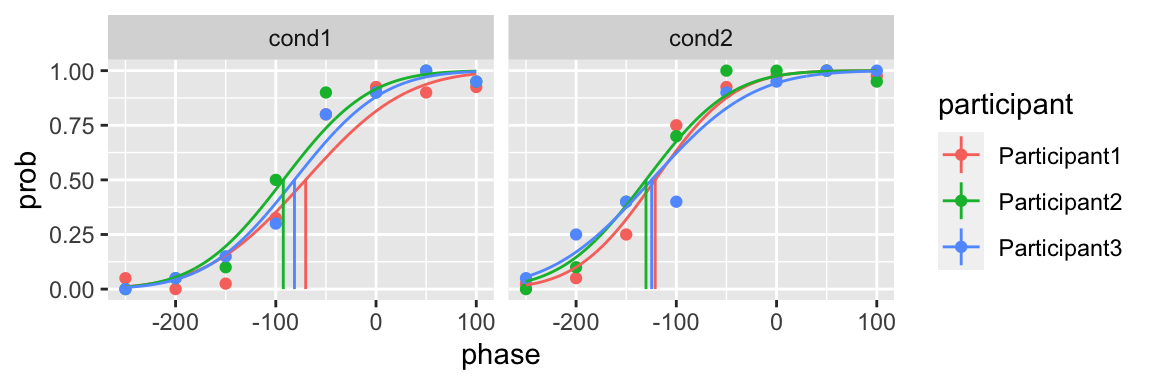
The dataframe could also contain the constraints of the parameters
parini <- conditions %>%
  crossing(participants) %>%
  crossing(tibble(parn = c("p1", "p2"))) %>%
  arrange(cond) %>%
  bind_cols(tibble(parmin = c(rep(c(-300, 10), 3),
                         rep(c(-500, 5), 3)),
                   parmax = c(rep(c(300, 200), 3),
                         rep(c(500, 400), 3))))
parini
#> # A tibble: 12 x 5
#>    cond  participant  parn  parmin parmax
#>    <chr> <chr>        <chr>  <dbl>  <dbl>
#>  1 cond1 Participant1 p1      -300    300
#>  2 cond1 Participant1 p2        10    200
#>  3 cond1 Participant2 p1      -300    300
#>  4 cond1 Participant2 p2        10    200
#>  5 cond1 Participant3 p1      -300    300
#>  6 cond1 Participant3 p2        10    200
#>  7 cond2 Participant1 p1      -500    500
#>  8 cond2 Participant1 p2         5    400
#>  9 cond2 Participant2 p1      -500    500
#> 10 cond2 Participant2 p2         5    400
#> 11 cond2 Participant3 p1      -500    500
#> 12 cond2 Participant3 p2         5    400
Data frame of functions (dev version of quickpsy)
When the fun argument is a data frame of functions, you should specify all the parameters included in the functions
library(dplyr)

fun_df <- tibble(cond = c("cond1", "cond2"),
                 fun = c(function(x, p) (1 + exp(-p[2] * (x - p[1])))^(-1),
                         function(x, p) (1 + exp(-p[2] * (x - p[3])))^(-1)))

fit <- quickpsy(qpdat, phase, resp, grouping = c("participant", "cond"),
                fun = fun_df, # shared slope parameter
                parini = c(-100, 0.02, -100),
                bootstrap = "none")

plot(fit, color = cond)